From Here to There: Alec Soth's America
September 12, 2010 - January 2, 2011
Target Gallery at The Walker Art Center
The
Walker presents the first U.S. survey of the work of Alec Soth, one of
the most compelling voices in contemporary photography, whose offbeat
images of everyday America form powerful narrative vignettes. Featuring
more than 100 photographs made between 1994 and the present, the
exhibition includes examples from Soth’s well-known series Sleeping by the Mississippi and Niagara,
a selection of rarely seen early black-and-white work, and a broad
range of portraits. Also on view is the Minneapolis-based artist’s
newest series, Broken Manual, exploring places of escape in and individuals who seek to flee civilization for a life “off the grid.”
Working in a photographic tradition of road photography established
by such figures as Walker Evans, Robert Frank, William Eggleston, and
Stephen Shore, Soth captures stunning large-scale color images often
using a cumbersome 8x10 field camera, with an eye toward finding
overlooked beauty in the banal. His curiosity, penchant for research,
and openness to serendipity in seeking out subjects have all become
hallmarks of his working process. The wanderlust embodied in Soth’s work
is an impulse to uncover his own versions of the narratives that
comprise the American experience. His images offer insight into broader
sociologies while forming an unexpected portrait of the country.
An illustrated catalogue accompanies the exhibition.
Curator: Siri Engberg
From Here to There: Alec Soth’s America is organized by the Walker Art Center.
Thursday, September 30, 2010

Exhibit: THE UNIVERSITY AVENUE PROJECT
PUBLIC ART SAINT PAUL PRESENTS
WING YOUNG HUIE'S
THE UNIVERSITY AVENUE PROJECT
THE LANGUAGE OF URBANISM: A SIX-MILE PHOTOGRAPHIC INQUIRY
FROM MAY THROUGH OCTOBER, 2010 WING YOUNG HUIE’S PHOTOGRAPHS WILL TRANSFORM SAINT PAUL’S UNIVERSITY AVENUE INTO A SIX-MILE PUBLIC GALLERY, REVEALING THE EVERYDAY REALITES OF THE DIVERSE NEIGHBORHOODS CONNECTED BY THIS URBAN THOROUGHFARE.
HUNDREDS OF IMAGES WILL BE DISPLAYED IN WINDOWS AND ON BUILDINGS FROM THE KSTP TOWER TO THE STATE CAPITOL.
EACH NIGHT AT A LANDMARK PROJECT(ION) SITE WING’S IMAGES WILL BE SHOWN ON 40 FOOT SCREENS, ACCOMPANIED BY A SOUNDTRACK FROM LOCAL MUSICIANS. MONTHLY CABARETS WILL FEATURE LIVE COMMUNITY PERFORMANCES AND NEW MEDIA PRESENTATIONS.
A TWO-PART BOOK FROM THE MINNESOTA HISTORICAL SOCIETY PRESS DOCUMENTS THIS EXTRAORDINARY PROJECT.
WING YOUNG HUIE'S
THE UNIVERSITY AVENUE PROJECT
THE LANGUAGE OF URBANISM: A SIX-MILE PHOTOGRAPHIC INQUIRY
FROM MAY THROUGH OCTOBER, 2010 WING YOUNG HUIE’S PHOTOGRAPHS WILL TRANSFORM SAINT PAUL’S UNIVERSITY AVENUE INTO A SIX-MILE PUBLIC GALLERY, REVEALING THE EVERYDAY REALITES OF THE DIVERSE NEIGHBORHOODS CONNECTED BY THIS URBAN THOROUGHFARE.
HUNDREDS OF IMAGES WILL BE DISPLAYED IN WINDOWS AND ON BUILDINGS FROM THE KSTP TOWER TO THE STATE CAPITOL.
EACH NIGHT AT A LANDMARK PROJECT(ION) SITE WING’S IMAGES WILL BE SHOWN ON 40 FOOT SCREENS, ACCOMPANIED BY A SOUNDTRACK FROM LOCAL MUSICIANS. MONTHLY CABARETS WILL FEATURE LIVE COMMUNITY PERFORMANCES AND NEW MEDIA PRESENTATIONS.
A TWO-PART BOOK FROM THE MINNESOTA HISTORICAL SOCIETY PRESS DOCUMENTS THIS EXTRAORDINARY PROJECT.
Legacies of War
Legacies of War
Daily from
Thu., September 30 until Sun., October 24
Legacies of War
Sheila Regan
From 1964 to 1973,
the United States waged a secret war in Laos, dropping 260 million
cluster bombs—the most dropped on any country in history. The bombings
destroyed many villages and displaced hundreds of thousands of Lao
civilians during the nine-year period. Lao refugees had no way to
communicate with the world about their experiences, except through
hand-drawn sketches etched in pencil, pens, crayons, and markers. These
drawings, which ultimately led to world awareness about the CIA's
covert war in Laos, are now part of an exhibit called "Legacies of War
National Traveling Exhibition," at Intermedia Arts. The historical
drawings are accompanied by photos, maps, and other relevant documents
about the decade-long bombing campaign, as well as archival and
contemporary images, art, and video. Included in the exhibit are
original audio interviews and documentary films depicting the lives of
those affected by the bombings, and their impact on the Laotian
diaspora. Local artist Malichansouk Kouanchao guest curates with the
inclusion of a piece titled Our Shared Journey, created by
contributions from local community members recruited by the Lao
Assistance Center of Minnesota. The opening reception is 7 p.m.
Thursday, September 30.
Monday, September 27, 2010
Captured: America in Color from 1939-1943
My friend Erin G shared this plog from the Denver Post with me. It is a beautiful and interesting collection of photographs from an important historical time in the world and in the U.S. These are the ones I chose out of the collection to share.
Captured: America in Color from 1939-1943
These images, by photographers of the Farm Security Administration/Office of War Information, are some of the only color photographs taken of the effects of the Depression on America’s rural and small town populations. The photographs are the property of the Library of Congress and were included in a 2006 exhibit Bound for Glory: America in Color.
Captured: America in Color from 1939-1943
These images, by photographers of the Farm Security Administration/Office of War Information, are some of the only color photographs taken of the effects of the Depression on America’s rural and small town populations. The photographs are the property of the Library of Congress and were included in a 2006 exhibit Bound for Glory: America in Color.
 |
| Chopping cotton on rented land near White Plains. White Plains, Greene County, Georgia, June 1941. Reproduction from color slide. Photo by Jack Delano. Prints and Photographs Division, Library of Congress |

 |
| Distributing surplus commodities. St. Johns, Arizona, October 1940. Reproduction from color slide. Photo by Russell Lee. Prints and Photographs Division, Library of Congress |

 |
| Homesteader and his children eating barbeque at the New Mexico Fair. Pie Town, New Mexico, October 1940. Reproduction from color slide. Photo by Russell Lee. Prints and Photographs Division, Library of Congress |

 |
| African American's tenant's home beside the Mississippi River levee. Near Lake Providence, Louisiana, June 1940. Reproduction from color slide. Photo by Marion Post Wolcott. Prints and Photographs Division, Library of Congress |

 |
| Boys fishing in a bayou. Schriever, Louisiana, June 1940. Reproduction from color slide. Photo by Marion Post Wolcott. Prints and Photographs Division, Library of Congress |
 |
| Switchman throwing a switch at Chicago and Northwest Railway Company's Proviso yard. Chicago, Illinois, April 1943. Reproduction from color slide. Photo by Jack Delano. Prints and Photographs Division, Library of Congress |

 |
| Women workers employed as wipers in the roundhouse having lunch in their rest room, Chicago and Northwest Railway Company. Clinton, Iowa, April 1943. Reproduction from color slide. Photo by Jack Delano. Prints and Photographs Division, Library of Congress |

 |
| Woman is working on a "Vengeance" dive bomber Tennessee, February 1943. Reproduction from color slide. Photo by Alfred T. Palmer. Prints and Photographs Division, Library of Congress |
 |
| Worker at carbon black plant. Sunray, Texas, 1942. Reproduction from color slide. Photo by Worker at carbon black plant John Vachon. Prints and Photographs Division, Library of Congress |

Sunday, September 26, 2010
A visit from the fire brigade
A quiet Friday evening quickly turned loud when a chemical stench and thick gray smoke came pouring out of the oven. Having made no-bake cookies earlier in the week, my roommate had forgotten that the place she'd left the cookies to settle and cool was still being occupied by the tasty treats when she turned on the oven to pre-heat it for a pizza.
The old rickety windows were too hard to get open in time to prevent the apartment building smoke alarm from blaring at full volume. Soon, the building was being evacuated and fire trucks were at our doorstep with sirens blaring. Terribly embarrassing, but most of the neighbors were nice about it. On the plus side, the fire fighters were pretty handsome.
When our handsome heroes gave the okay to return to the building, my roommate and I found a unique form of modern oven art awaiting our arrival.
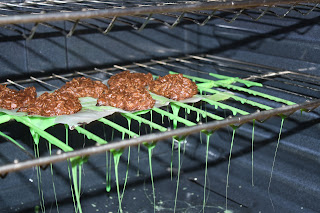
The thin plastic cutting board had almost entirely melted beneath the oatmeal peanut butter chocolate no-bake cookies and thin wax paper that held them.
While the stench of burned plastic filled our apartment for the remainder of the evening, with the help of the fan and fresh fall air circulating through the windows we finally got opened, it mostly dissipated by morning. Luckily, there was no permanent damage and we were able to remove every bit of the melted plastic from the oven. Whew! I wonder if I'll be getting a returned phone call from the property manager tomorrow. Guess we'll see...
The old rickety windows were too hard to get open in time to prevent the apartment building smoke alarm from blaring at full volume. Soon, the building was being evacuated and fire trucks were at our doorstep with sirens blaring. Terribly embarrassing, but most of the neighbors were nice about it. On the plus side, the fire fighters were pretty handsome.
When our handsome heroes gave the okay to return to the building, my roommate and I found a unique form of modern oven art awaiting our arrival.

The thin plastic cutting board had almost entirely melted beneath the oatmeal peanut butter chocolate no-bake cookies and thin wax paper that held them.
While the stench of burned plastic filled our apartment for the remainder of the evening, with the help of the fan and fresh fall air circulating through the windows we finally got opened, it mostly dissipated by morning. Luckily, there was no permanent damage and we were able to remove every bit of the melted plastic from the oven. Whew! I wonder if I'll be getting a returned phone call from the property manager tomorrow. Guess we'll see...
Wednesday, September 22, 2010
Recurring daydream
 | |
| Recurring daydream - Liftopia |
A recurring daydream during the precious fleeting warm summer days...of snow and ice, slopes and trees, for skiing and sliding with breathtaking scenes. Minnesota-born, I sneer at the cold, dark prospect of winter...replaced by a sweet hopeful smile.
Monday, September 20, 2010
Sunday, September 19, 2010
Monday, September 13, 2010
Exhibit: Homelessness is My Address, Not My Name
Letter to volunteers from Cathy ten Broeke, Coordinator to End Homelessness, Minneapolis/Hennepin County.
August 24, 2010
Greetings Project Homeless Connect Volunteers!
I hope this finds you all well and that you are gearing up for our next big
event on Monday, December 13!
Today, I am writing to invite you to a very special art exhibit. As you may
remember, at the last several Project Homeless Connect events, we have had a
section dedicated to gathering oral histories. A professional photographer
has also been on hand to take portraits of the families and individuals that
stop by. These portraits and the accompanying oral histories are now a part
of a new exhibit called Homeless is My Address, Not My Name. Please visit
www.homelessismyaddress.org<http://r20.rs6.net/tn.jsp?et=1103622424939&s=1470&e=001k1fJBuOogv5BAZJenRtohSFSQnEg-8ymsO--nrQM1AY0sq-Q4C4Mpq94-9PxB4_hYIU011wC3SqfWRn96N_pNv7JnYVvQ9rcqLe7H8bsXT8j2KCpnvAjoPgbzVxODrDv>to
view the invitation to join us on opening night at the Chambers Hotel
/Burnet Gallery in downtown Minneapolis on Wednesday, September 15 from
7:00-9:00 p.m. If you can't make it to the opening, please visit the
gallery from September 10-19 to see the exhibit.
A unique feature of the exhibit is that under several large portraits there
is a phone number. The viewer can call the number on their cell phone and
hear that person's story spoken in his or her own words and voice. It is
intimate and powerful. And, as many of you know, the portraits are
stunningly beautiful. I believe this exhibit will change the way people
think about homelessness. Thank you for your role in making this possible.
See you on September 15!
Cathy
Cathy ten Broeke
Coordinator to End Homelessness
Minneapolis/Hennepin County
August 24, 2010
Greetings Project Homeless Connect Volunteers!
I hope this finds you all well and that you are gearing up for our next big
event on Monday, December 13!
Today, I am writing to invite you to a very special art exhibit. As you may
remember, at the last several Project Homeless Connect events, we have had a
section dedicated to gathering oral histories. A professional photographer
has also been on hand to take portraits of the families and individuals that
stop by. These portraits and the accompanying oral histories are now a part
of a new exhibit called Homeless is My Address, Not My Name. Please visit
www.homelessismyaddress.org<http://r20.rs6.net/tn.jsp?et=1103622424939&s=1470&e=001k1fJBuOogv5BAZJenRtohSFSQnEg-8ymsO--nrQM1AY0sq-Q4C4Mpq94-9PxB4_hYIU011wC3SqfWRn96N_pNv7JnYVvQ9rcqLe7H8bsXT8j2KCpnvAjoPgbzVxODrDv>to
view the invitation to join us on opening night at the Chambers Hotel
/Burnet Gallery in downtown Minneapolis on Wednesday, September 15 from
7:00-9:00 p.m. If you can't make it to the opening, please visit the
gallery from September 10-19 to see the exhibit.
A unique feature of the exhibit is that under several large portraits there
is a phone number. The viewer can call the number on their cell phone and
hear that person's story spoken in his or her own words and voice. It is
intimate and powerful. And, as many of you know, the portraits are
stunningly beautiful. I believe this exhibit will change the way people
think about homelessness. Thank you for your role in making this possible.
See you on September 15!
Cathy
Cathy ten Broeke
Coordinator to End Homelessness
Minneapolis/Hennepin County
Friday, September 10, 2010
Accidental Mysteries as created by John Foster
'About' Accidental Mysteries: "John and Teenuh Foster
share a passionate interest in collecting works of art by self-taught
artists, as well as anonymous objects that to them, share attributes of
great design and mystery. They consider vernacular photography to be a
long overlooked genre of folk art, capturing elements of history,
sociology, psychology and often “accidental” moments on film. John is a
founder and past-president of ENVISION Folk Art of Missouri, where he
also served as editor of the Journal that he produced for ten years.
John serves on the Board of Trustees for SPACES
(Saving and Preserving Arts and Cultural Environments) which is based
in Aptos, California. Additionally, John is a member of the Advisory
Board of The Folk Art Society of America"
Garage Sale Masterpieces as found by John Foster
Newsweek: John Foster is a meticulous and savvy collector—"and I do not buy in bulk," he says. Over the years that he's been collecting personal photographs from garage sales, antique shops, and eBay—including the last 10 to 12 years of hard-core buying—he's assembled roughly 1,500 photographs that, to him, represent true found-art. Rare is the weekend he doesn't hit up a flea market or dusty old antiques store, locate a box of old photos, and rifle through them one by one, searching for the single, perfect shot. "It's not of any particular period of time, it's not any particular type of photograph, it's not any particular style," he says. "It's all about the image—how does it transcend the ordinary?" The price of transcendence? As little as $10, or as much as $400—"if you're buying from people who know what they are."
For decades, Foster and his wife have also collected various forms of folk art for their St. Louis home, a passion that has informed his photo quest. "When you look at the idea of enjoying art that's made by people without formal art education, you can easily make the jump to snapshots," he says. "Everyone takes photographs."
Photo: A young boy with smeared with either mud or pancake makeup grins giddily for the camera. "When I look for images, I look for something that makes you almost uncomfortable in your own skin—something that makes you observe more intently," Foster says. "That's when I know I have something that's more than just a snapshot."
Tuesday, September 7, 2010
Subscribe to:
Comments (Atom)